Family is a warm harbor, but there will be all kinds of small accidents at any time. How to accurately judge and implement first aid in the first time has become a knowledge we must master.
1. Avoid taking analgesics for acute abdominal pain: to avoid covering up the condition and delay the diagnosis, you should go to the hospital as soon as possible.
2. Do not reset immediately after visceral prolapse due to abdominal injury: the prolapsed viscera must be thoroughly disinfected by the doctor before reduction. Prevent infection from causing serious consequences.
3. Do not use tourniquet ligation time is too long: tourniquet should be relaxed every 1 hour for a quarter of an hour, and make records to prevent ischemia and necrosis of distal limbs caused by long ligation of limbs.
4. Coma patients should not lie on their back: should be made to lie on their side to prevent oral secretions, vomit inhaled respiratory tract caused by asphyxia. They can't feed or water for comatose patients.
5. Patients with cardiogenic asthma should not lie on their back: lying on their back will increase the blood stasis in the lungs and the burden on the heart, aggravate asthma and endanger life. Half lying position should be adopted to make the lower limbs droop.
6. Patients with cerebral hemorrhage should not be moved at will: if there is a paralyzed person who falls down suddenly or suffers from cerebral hemorrhage in the activity, it is likely that there will be cerebral hemorrhage. If the patient is moved at will, the bleeding will be more serious. They should lie on their back, raise their heads and send them to the hospital immediately.
7. Do not bandage the small and deep wounds carelessly: if the wounds are punctured by sharp instruments, the wounds will be anoxic, resulting in the growth of anaerobic bacteria such as tetanus. Wound cleaning and disinfection should be followed by bandaging and injection of tetanus antitoxin.
8. Diarrhea patients avoid taking antidiarrheal drugs: in the absence of anti-inflammatory before using antidiarrheal drugs, will make the toxin difficult to discharge, intestinal inflammation intensified. Should be used in the use of anti-inflammatory drugs, berberine, norfloxacin after the use of antidiarrheal drugs, such as easy to stop.
9. Do not pull with bare hands for rescue: if someone is found to have an electric shock, cut off the power supply immediately, and use dry sticks, bamboo Yu and other insulators to line up the wires.
First aid kit
Available sterile cotton; sterile gauze; dressing bag; adhesive tape; bandage (2 'and 3'; medicinal wine; mild disinfectant such as javelon; adhesive tape; safety pin; scissors; triangular towel; disposable gloves.
For the situation
Head trauma
Objective: To observe the injured and send them to the hospital for diagnosis and treatment.
1. If unconscious, see "unconscious"
If there is bleeding, refer to the treatment of the wound. The blood supply artery of the corresponding area can be compressed to stop bleeding.
If the situation is serious, it should be sent to the hospital for treatment.
In case of vomiting, place in recovery position.
2. 48 hours after the head injury, if there are any of the following phenomena, you should go to the hospital immediately for examination:
A, dizziness and vomiting;
B. headache;
C. neck pain and stiffness;
D, unconsciousness, incoherence or part of the body out of control;
E. drowsiness.
shock
Objective: to test and treat shock and send to hospital for treatment.
1. Pale skin, cold sweating and rapid pulse, if more than 100 times per minute, are signs of shock.
2. One way to deal with shock is to raise the feet and increase the blood supply to the heart and brain.
3. Keep the injured warm.
4. Inform the doctor immediately or send to the emergency department.
fracture
Objective: to fix the injured limb to relieve pain and send to hospital as soon as possible.
1. Observe the fracture site: (1) unable to move normally, the pain will increase with the activity or touch, the wound swelling, and then blood stasis is a closed fracture. (2) Unable to move, visible broken bone end, open fracture.
2. If there is shock or respiratory obstruction symptoms, it should be treated first.
3. The injured should not be moved casually unless the situation is life-threatening.
4. If there is a wound, clean gauze or dressing can be used to cover and bandage.
5. Fixation of broken bone: stabilize and support the upper and lower position of the broken bone, fix the broken bone position with wood board or bamboo pole, with the length exceeding the upper and lower joints as the principle, and then bandage to bind the injured limb with the body.
6. Immediately send to the hospital for treatment.
nose bleeding
Objective: to stop bleeding and reduce blood reflux.
1. Let the injured person sit or stand, do not lie down, head slightly forward.
2. He was advised to breathe with his mouth and hold the cartilage of his nose with a little force of his hand.
3. Ask him to vomit the blood in his mouth, because swallowing blood may cause nausea, vomiting, etc.
4. If a lot of bleeding, should be sent to the hospital immediately.
5. If there is a small amount of bleeding, release the pressure after 10 minutes. If there is still bleeding, press for another 10 minutes. Don't let the injured raise their heads for the time being.
6. If the bleeding does not stop after 30 minutes, the patient should be sent to the hospital for treatment.
get an electric shock
Objective: to get rid of power supply and send to hospital as soon as possible.
1. Cut off the current quickly before contacting the injured.
2. If the current cannot be cut off, the injured can be separated from the power supply by insulating objects such as bamboo, wood or wooden chair.
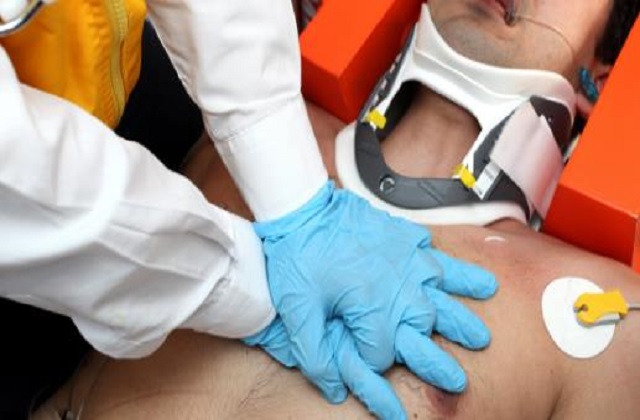
3. Check the condition of the injured person. If the heartbeat and breathing stop, cardiopulmonary resuscitation should be carried out immediately.
4. Immediately inform the ambulance to send them to the hospital for treatment.
poisoning
Objective: to dilute poison and send to hospital as soon as possible.
Taking drugs or chemicals by mistake
Symptoms: vomiting, abdominal pain, cramps, delirium, coma, dyspnea, smeared marks on the corners of the mouth.
1. If the injured person is sober, and the ingestion is determined to be corrosive, gastric lavage is prohibited, and fresh milk or egg white and other lubricants can be allowed to drink to prevent absorption.
2. If the injured person is unconscious, do not give him any food or drink to prevent the food or liquid from flowing into the respiratory tract.
3. Take them to the hospital together with samples of toxic substances and vomitus to provide direction for further treatment.
4. If you have vomiting or diarrhea after 12 hours, you should still drink more water and seek medical advice as soon as possible.
Gas or petroleum gas poisoning
1. Cover your mouth and nose with a handkerchief or hold your breath.
2. Open all doors and windows, do not open or close electrical appliances or ignite fire.
3. Turn off the gas supply.
4. Move the injured person to a place with fresh air circulation.
5. Call the ambulance safely.
6. If the injured person stops breathing, artificial respiration should be carried out immediately.